


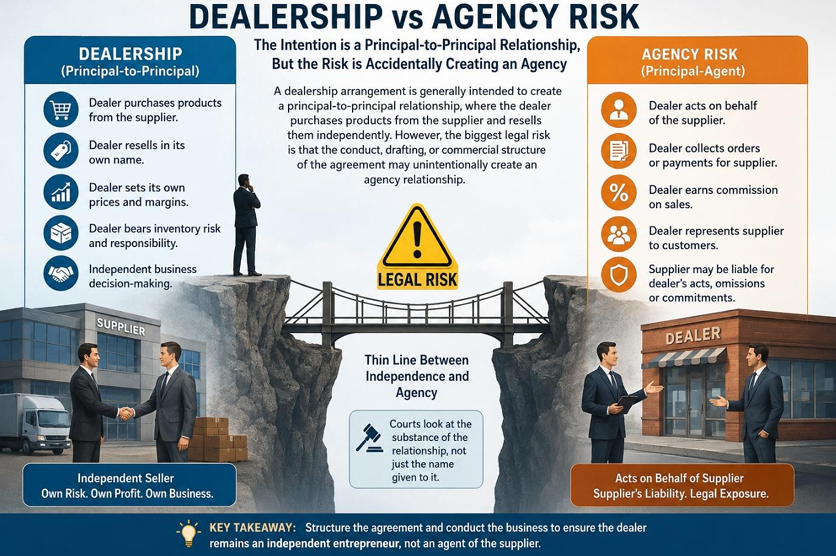
KEY LEGAL RISK IN DEALERSHIP AGREEMENTS
Dealership Arrangement vs Agency Relationship – Legal Risks and Practical Considerations
A dealership arrangement is generally intended to create a principal-to-principal relationship, where the dealer purchases products from the supplier and resells them independently. However, the biggest legal risk is that the conduct, drafting, or commercial structure of the agreement may unintentionally create an agency relationship.
The real issue is whether the dealer is carrying on an independent trading activity for its own account, or whether the arrangement effectively makes the dealer a representative vehicle through which the supplier conducts its business?
Why does this matter?
Because once a dealer is treated as an agent, the supplier/principal may become liable for the acts, representations, commitments, or omissions of the dealer while acting within the scope of the agency.
The question is therefore not only “What does the agreement call the relationship?” but also:
“How will a court view the actual commercial arrangement?”
Courts generally examine actual rights, obligations, and conduct of the parties, and not merely by the label assigned in the agreement.
A. Is the Dealer Really an Independent Seller or an Agent of the Company?
A dealer may be called an “independent distributor” in the agreement, but the following questions must be considered:
1. Does the Dealer Buy Goods or Merely Sell Goods on Behalf of the Company?
Risk Indicator
If the agreement suggests that the dealer is only collecting orders, earning a percentage, or acting as a sales channel of the company, it may create an impression of agency.
Precaution
The agreement should clearly state:
- The dealer purchases products from the supplier on a principal-to-principal basis.
- The dealer resells such products in its own name.
- The dealer determines its own resale strategy and commercial margins.
- The dealer is not selling products as an agent or representative of the supplier.
Illustration
Dealer A purchases 1,000 units from Manufacturer B, pays the invoice price, stores the goods, and sells them to customers at a price determined by Dealer A. This indicates a buyer-seller relationship.
However:
If Dealer A merely procures orders, collects payments on behalf of Manufacturer B, and receives a fixed percentage of every sale, it may indicate an agency arrangement.
B. Does the Dealer Have Authority to Bind the Supplier?
Can the dealer make commitments on behalf of the supplier? If yes, the supplier may be exposed to liability.
The agreement should expressly provide:
- The dealer has no authority to create any obligation on behalf of the supplier.
- The dealer cannot sign contracts, warranties, assurances, or commitments in the supplier’s name.
- Any representation made by the dealer beyond authorised marketing material shall be the dealer’s responsibility.
Illustration
A dealer promises a customer:
Company X will provide a five-year replacement guarantee.
If the dealer had no authority to give such assurance, the company should not automatically be bound.
C. Is the Dealer Taking Business Risk or Acting as a Representative?
An independent dealer normally bears commercial risks.
The agreement should clarify that:
- The dealer purchases inventory at its own risk.
- The dealer bears the risk of loss, damage, deterioration, and unsold stock.
- The supplier is not responsible for the dealer’s resale decisions.
Illustration
Dealer purchases seasonal products and cannot sell the entire stock. If the dealer bears the loss, it supports a dealership model.
If the supplier is obligated to take back unsold inventory or guarantee dealer profit, it may resemble an agency or commission arrangement.
D. Avoid Language Suggesting Commission-Based Agency
One common drafting mistake is using expressions such as:
Dealer shall receive 10% commission on sales.
This language may imply that the dealer is earning for selling on behalf of the supplier.
Better wording:
The dealer’s income shall arise from the difference between the purchase price paid to the supplier and the resale price charged by the dealer.
The dealer’s profit is independent and not a commission.
E. Marketing Rights vs Agency Rights
A dealer may be permitted to promote products and use trademarks. However, the agreement must distinguish:
Permitted
- Advertising products.
- Displaying trademarks under licence.
- Conducting promotional activities.
Not Permitted
- Representing itself as the company.
- Entering contracts for the company.
- Giving warranties beyond authorised terms.
- Making commitments binding on the supplier.
Illustration
A dealer may say:
Authorised dealer of Company X.
But should not say:
I represent Company X and can negotiate contracts on its behalf.
Judicial Approach: Substance Over Form
Example 1 – Distributor Purchasing and Reselling Independently
A distributor claimed that it was acting as an agent and challenged termination of the distributorship.
The court examined the actual arrangement and observed:
- The distributor purchased goods.
- It paid for the products.
- It carried inventory risk.
- It resold independently.
Although certain expressions suggested agency, the actual conduct showed a dealer relationship and not a principal-agent relationship.
Example 2 – Independent Resale for Profit
One can argue that a commercial arrangement created an agency relationship.
The court held that where one party purchases goods for itself and resells them independently for profit, it is acting as an independent trader and not as an agent.
The essential test was:
Was the party acting for itself or on behalf of another?
Example 3 – Defective Product Sold Through Authorised Dealer
A customer purchased a defective product from an authorised dealer and attempted to hold both dealer and manufacturer responsible.
The legal position depends on the nature of the relationship:
- The dealer remains responsible for its own sales conduct, representations, and obligations.
- The manufacturer’s liability depends on applicable product liability principles and statutory obligations.
- The mere appointment of a dealer does not automatically make the dealer an agent of the manufacturer.
Author
Nirupama Kar
Advocate | Notary | Company Secretary Executive Level | Independent Director